
This course covers the foundational mathematical skills in whole numbers, addition and subtraction, multiplication and division, money, measurement, geometry, and basic statistics. Pupils will learn to work with numbers up to 100, understand place value, and apply basic arithmetic operations in simple contexts. The course also introduces early concepts of measurement using standard units, basic time-telling skills, recognition of 2D shapes, and interpretation of simple data using picture graphs.
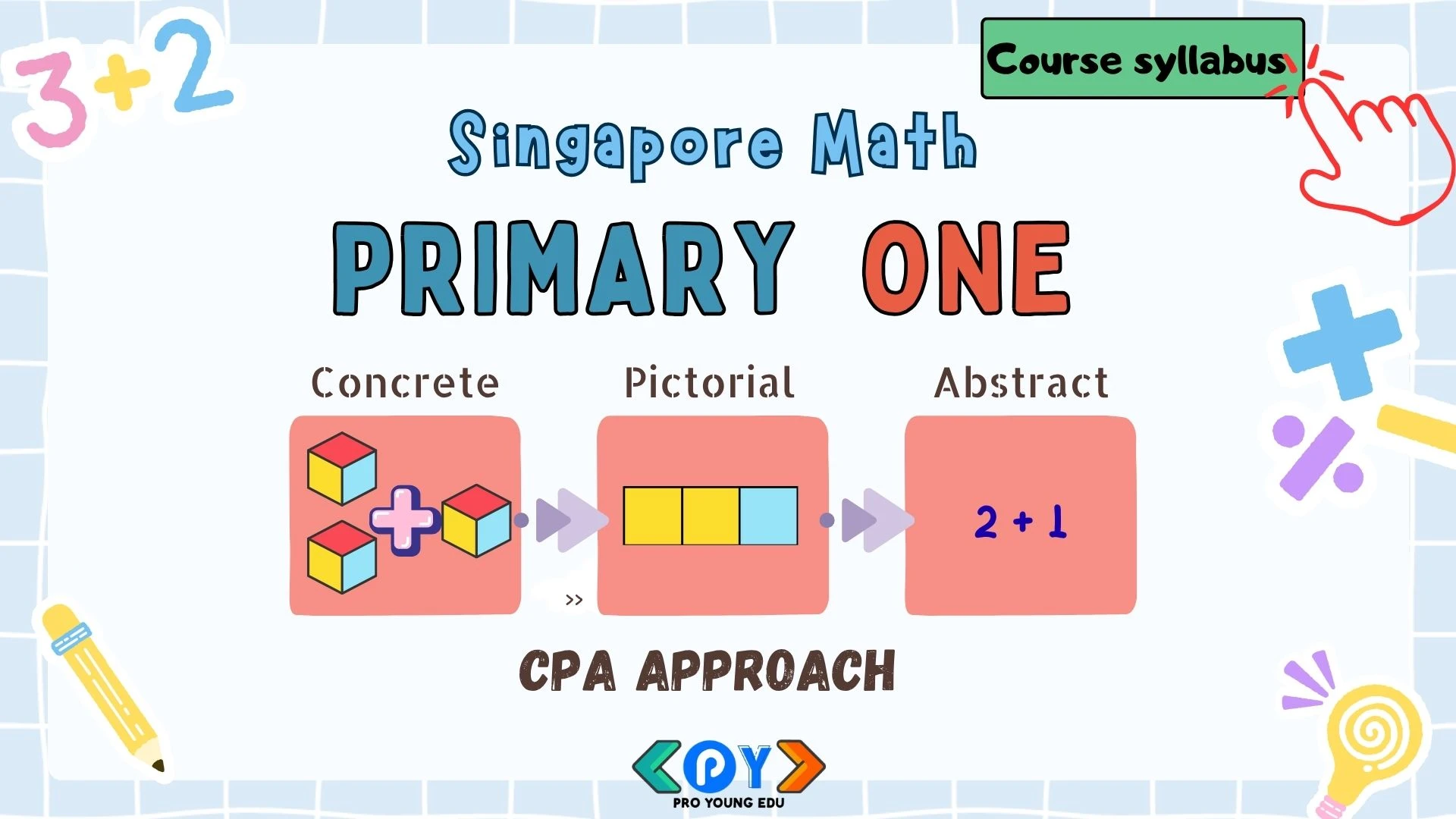
| PRIMARY 1 | |
| Chapter | Topic |
| Chapter 1 | Numbers within 10 |
| Chapter 2 | Adding numbers within 10 |
| Chapter 3 | Subtracting Numbers within 10 |
| review 1 | |
| Chapter 4 | Shapes |
| Chapter 5 | Ordinal Numbers and Positions |
| review 2 | |
| Chapter 6 | Numbers within 20 |
| Chapter 7 | Adding and Subtracting Numbers within 20 |
| review 3 | |
| Chapter 8 | Picture Graphs |
| Chapter 9 | Numbers within 100 |
| review 4 | |
| mid-year review | |
| Chapter 10 | Addition and Subtraction within 100 |
| Chapter 11 | Length |
| review 5 | |
| Chapter 12 | Multiplication |
| Chapter 13 | Division |
| review 6 | |
| Chapter 14 | Time |
| Chapter 15 | Money |
| review 7 | |
| final review | |
| SUB-STRAND: WHOLE NUMBERS |
| 1. Numbers up to 100 |
| 1.1 counting to tell the number of objects in a given set
1.2 number notation, representations and place values (tens, ones) 1.3 reading and writing numbers in numerals and in words 1.4 comparing the number of objects in two or more sets 1.5 comparing and ordering numbers 1.6 patterns in number sequences 1.7 ordinal numbers (first, second, up to tenth) and symbols (1st, 2nd, 3rd, etc.) |
| 2. Addition and Subtraction |
| 2.1 concepts of addition and subtraction
2.2 use of +, – and = 2.3 relationship between addition and subtraction 2.4 adding more than two 1-digit numbers 2.5 adding and subtracting within 100 2.6 adding and subtracting using algorithms 2.7 mental calculation involving addition and subtraction
|
| 3. Multiplication and Division |
| 3.1 concepts of multiplication and division
3.2 use of x 3.3 multiplying within 40 3.4 dividing within 20 |
| SUB-STRAND: MONEY |
| 1. Money |
1.1 counting amount of money
|
| SUB-STRAND: MEASUREMENT |
| 1. Length |
| 1.1 measuring length in centimetres
1.2 use of abbreviation cm 1.3 comparing and ordering lengths in cm 1.4 measuring and drawing a line segment to the nearest cm |
| 2. Time |
| 2.1 telling time to 5 minutes
2.2 use of ‘am’ and ‘pm’ 2.3 use of abbreviations h and min 2.4 duration of one hour/half hour |
| SUB-STRAND: GEOMETRY |
| 1. 2D Shapes |
1.1 identifying, naming, describing and classifying 2D shapes
1.2 forming different 2D figures with
1.3 identifying the 2D shapes that make up a given figure 1.4 copying figures on dot grid or square grid |
| SUB-STRAND: DATA REPRESENTATION AND INTERPRETATION |
| 1. Picture Graphs |
| 1.1 reading and interpreting data from picture graphs |

Whether online or in-class, our enrichment programmes help children grow into confident, capable, and future-ready learners.
Start Now!