
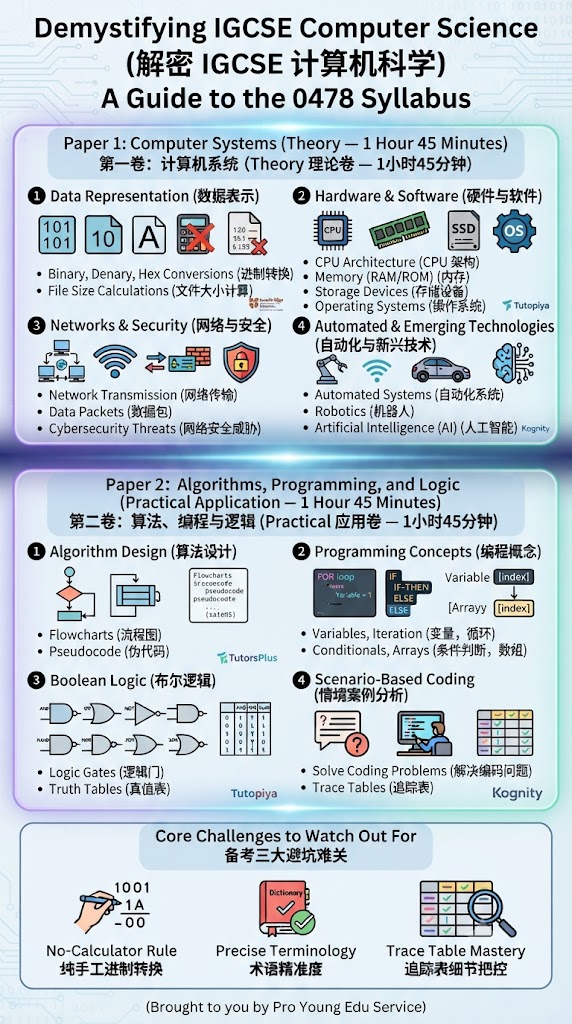
A Guide to the 0478 Syllabus
As technology continues to reshape global industries, IGCSE Computer Science (Syllabus 0478) has become one of the most popular choices for students aiming for future paths in software engineering, AI, and data science.
Unlike general IT courses that focus on using basic software tools, Computer Science dives under the hood to teach students how computers actually work and how to build computational solutions. Here is a comprehensive overview of how the exam is structured and what students are required to master.
Cambridge International Education
The Two-Part Assessment Structure
The Cambridge IGCSE Computer Science qualification is split evenly between theory and practical application, with both papers holding an equal 50% weighting:
TutorsPlus
1. Paper 1: Computer Systems (Theory — 1 Hour 45 Minutes)
This paper focuses on the architecture, communication, and operational frameworks of computing devices. Key topics include:
Save My Exams
- Data Representation: Converting between binary, denary, and hexadecimal systems, as well as calculating file sizes for text, sound, and images.
Tutopiya - Hardware & Software: The inner workings of the Central Processing Unit (CPU), types of memory (RAM vs.ROM), storage devices, and Operating Systems (OS).
Tutopiya - Networks & Security: How data is transmitted across networks, data packet protocols, and protection against cybersecurity threats (malware, hacking, phishing).
Save My Exams - Automated & Emerging Technologies: Real-world foundations of automated systems, robotics, and Artificial Intelligence (AI).
Scribd
2. Paper 2: Algorithms, Programming, and Logic (Practical Application — 1 Hour 45 Minutes)
This paper shifts from rote facts to computational logic, thinking, and problem-solving. Key components include:
- Algorithm Design: Using flowcharts and structured Pseudocode to map out logical solutions step-by-step.
TutorsPlus - Programming Concepts: Declaring variables, conditional logic (IF-THEN-ELSE), iterations (FOR, WHILE loops), handling arrays, and file data tracking.
- Boolean Logic: Constructing and interpreting digital circuits using logic gates (AND, OR, NOT, NAND, NOR, XOR) and managing truth tables.
TutorsPlus - Scenario-Based Coding: Writing, tracing, or debugging a multi-line program based on a given problem statement to test real-world developer logic.
Core Challenges to Watch Out For
- The No-Calculator Rule: Students must perform all binary, denary, and hexadecimal conversions manually without a calculator.
- Precise Key Terminology: Credit is only given when students use precise industry terminology (e.g., using terms like ALU, Registers, or Interrupts) rather than vague explanations.
Tutopiya - Trace Tables Mastery: Paper 2 frequently tests a student’s ability to “dry run” code by executing an algorithm step-by-step using a trace table to monitor shifting variable values.
Tutopiya
IGCSE 计算机科学大纲全解析
在科技重塑全球产业的当下,IGCSE 计算机科学(科目代码 0478) 已然成为有意向在软件工程、人工智能(AI)和数据科学等领域发展的学生们的黄金选择。
与侧重于“如何操作软件”的常规信息技术(ICT)课程不同,计算机科学带孩子们深入系统的底层,探索“计算机究竟是如何运转的”以及“如何通过代码编写解决现实问题”。以下为您带来该大纲的全面剖析:
核心考核双轨制结构
剑桥 IGCSE 计算机科学考试将理论知识与实际应用进行了精准的对半拆分,两卷各占最终总成绩的 50%:
1. 第一卷:计算机系统 (Theory 理论卷 — 1小时45分钟)
本试卷全面考察计算机的硬件架构、通信以及系统运行框架,核心板块包括:
- 数据表示 (Data Representation): 二进制、十进制与十六进制之间的相互转换,以及文本、音频、图像文件的大小计算。
TutorsPlus - 硬件与软件 (Hardware & Software): 中央处理器(CPU)的核心架构与运转周期、内存(RAM 与 ROM)的区别、各类存储媒介以及操作系统(OS)的职能。
Tutopiya - 网络与安全 (Networks & Security): 数据在网络中的传输方式与协议、数据包的结构,以及应对网络安全威胁(恶意软件、黑客攻击、钓鱼网站)的防御机制。
Save My Exams - 自动化与新兴技术 (Automated & Emerging Technologies): 自动化系统、机器人技术以及人工智能(AI)的底层逻辑与社会影响。
Scribd
2. 第二卷:算法、编程与逻辑 (Practical 应用卷 — 1小时45分钟)
本试卷完成了从“背诵定义”到“逻辑推演”的转变,对考生的计算思维和实操问题解决能力有着极高要求:
- 算法设计 (Algorithm Design): 熟练运用流程图(Flowcharts)和官方规范的伪代码(Pseudocode),将解题步骤逻辑化地呈现。
TutorsPlus - 编程核心概念 (Programming): 变量声明、条件分支(IF-THEN-ELSE)、循环迭代(FOR, WHILE 循环)、数组的处理以及文件读写。
- 布尔逻辑 (Boolean Logic): 运用逻辑门(AND, OR, NOT, NAND, NOR, XOR)绘制与分析数字电路,并推导真值表(Truth Tables)。
TutorsPlus - 情境案例分析 (Scenario-based Questions): 考试取消了原有的预发布代码,取而代之的是现场给出一个复杂的业务逻辑情境,要求考生直接编写、追踪或调试多行代码,模拟开发者的真实工作状态。
Kognity
备考三大避坑难关
- 纯手工进制转换: 考试全程禁止使用计算器。所有二进制加法、十六进制转换与存储空间计算必须全靠手算。
- 术语精准度要求高: 阅卷官十分看重专业术语的准确运用。考生在阐述原理时,必须使用诸如 ALU(算术逻辑单元)、Registers(寄存器)、Interrupts(中断) 等特定名词,语意模糊的口语化解释将无法得分。
Tutopiya - 追踪表 (Trace Tables) 的细节把控: 第二卷高频考察代码的“盲跑”能力(Dry Run)。考生需要通过追踪表,一步步记录算法在执行过程中每一个变量的动态数值变化,漏掉一步便会全盘失分。
Tutopiya
(Brought to you by Pro Young Edu Service)
